
The EU Ecodesign for Sustainable Products Regulation
A paradigm shift with impacts on almost all companies
EXECUTIVE SUMMARY:
- The Ecodesign for Sustainable Products Regulation has been in force since July 2024. In the long term, it will affect almost all new products launched in the EU.
- The objective of the regulation: A circular EU economy – through improved repairability, recyclability, reusability, and durability, as well as strengthening the internal market.
- The regulation is designed as a framework act, with specific product requirements to be followed by delegated acts.
- A five-year work plan was published in April 2025, listing the product groups that will be prioritized in delegated acts in the coming years.
- Key elements: performance and information requirements (e. g., recycled content, durability) and the Digital Product Passport.
- The ESPR will affect numerous companies in the future. They can already prepare specifically today – for example, through an early assessment of their products and corporate resources, the systematic development of data availability, and the gradual implementation of circular product design principles.
Climate change has rightly dominated public discourse for years. But another profound challenge is increasingly coming into focus: the linear economic system that dominates our production and consumption model. Following the principle of "make, use, discard," valuable raw materials are extracted, transformed into short-lived products, and disposed of after use. The consequences are well known: dwindling resources, growing amounts of waste, and significant environmental pollution.
This is exactly where the EU comes in: Because around 80 % of a product's environmental impacts arise during the design phase, the EU Ecodesign for Sustainable Products Regulation (ESPR) requires that products be designed sustainably right from the start.
The ESPR entered into force on July 18, 2024, and replaces the previous Ecodesign Directive 2009/125/EC, which was limited exclusively to energy-related products. In the future, the regulation will apply to almost all physical products – with a few exceptions such as food, feed, pharmaceuticals, and vehicles (regulated separately, see: End-of-Life Vehicles Directive). For the first time, circular economy principles such as durability, repairability, reusability, and recyclability are at the center of mandatory product requirements.
An important milestone followed recently: On April 16, 2025, the Ecodesign Forum published the Ecodesign for Sustainable Products and Energy Labelling Working Plan 2025-2030, which defines concrete next steps.
Objectives of the ESPR
The ESPR aims to comprehensively improve the sustainability of products through binding requirements for their design and published information. The core objectives are as follows:
- Increase product sustainability: Products should become more durable, energy-efficient, repairable, reusable, and recyclable. At the same time, CO₂ and material footprints should be reduced.
- Increase transparency: Improved and standardized sustainability information should enable consumers, companies, and public institutions to make informed decisions. Stakeholders along the value chain – such as recyclers – should also benefit from a better flow of information.
- Strengthen internal markets: A uniform legal framework should reduce compliance costs, as the same requirements apply across the EU. At the same time, the ESPR aims to stimulate investment, product innovation, and circular business models – with the goal of establishing the EU as a pioneering market for the circular economy.
According to its own impact assessment, the EU Commission expects several positive effects of the ESPR, in particular:
- Creation of numerous jobs, particularly in areas such as remanufacturing, maintenance, recycling, and repair
- Increased supply and demand for secondary raw materials
- Provenly more sustainable purchasing decisions by consumers
- Environmental benefits, including a noticeable reduction in greenhouse gas emissions.
Regulatory implementation
The ESPR is designed as a framework legal act – meaning that specific requirements for individual product groups or overarching categories will in future be established through delegated acts of the European Commission. These are directly legally binding, as they do not require further adoption by the European Parliament or the Council.
The EU Commission defines which products should be regulated as priorities in the near future in its work plans. The first of these plans – the Ecodesign for Sustainable Products and Energy Labelling Working Plan 2025-2030 – was developed by the Ecodesign Forum and published on April 16, 2025. It is valid for a period of five years.
According to the work plan, delegated acts are to be adopted in the coming years for the following prioritized product groups or categories:
- Iron and steel
- Aluminum
- Textiles (focus on clothing)
- Furniture
- Tires
- Mattresses
In addition, the work plan calls for the Commission to introduce horizontal measures (i. e., cross-product requirements that apply to multiple products within a product group) on the repairability of products such as consumer electronics and small household appliances. This includes a repairability score for particularly relevant product groups. Binding requirements for the recyclability of electrical and electronic equipment are also planned.
Core content to be specified by delegated acts
Performance and information requirements
The product requirements laid down in the delegated acts may include performance requirements, information requirements or a combination of both.
Performance requirements refer to a specific product parameter and can include minimum or maximum values for the product parameter or requirements for a product's functional performance. Examples include an upper limit for energy consumption, a minimum share of recycled materials, or a minimum use of renewable resources.
Information requirements relate to product-specific information such as the carbon footprint, instructions for installation, use, maintenance, and repair, as well as information for treatment facilities for dismantling, reuse, repair, recycling, or disposal. The legislation should also specify how this information is to be published – the Digital Product Passport (see below) will play a central role in this, but product labels or information on the website are also conceivable.
The 2025-2030 work plan provides for both specific performance and information requirements for the prioritized product groups.
The Digital Product Passport
The Digital Product Passport (DPP) is a key instrument of the ESPR, the specific design of which will be defined in the respective delegated acts. Depending on the type of product, both product-specific and component-specific passports (i. e., for individual parts of a product) can be provided. The DPP is intended to provide all information defined in the respective information requirements, such as material composition, repairability, recyclability, or the CO₂ footprint. Furthermore, it is intended to ensure traceability along the entire value chain. The goal is standardized, needs-based data access for companies, consumers, and authorities based on uniform EU standards.
The passport will be accessible directly on the product via a machine-readable data carrier. The IT infrastructure for the DPP with harmonized standards is currently being developed by CEN/CENELEC and is expected to be available by the end of 2025. There is currently no agreement on a specific technology for display (e. g., QR code or NFC chip).
Regulations for the destruction of unsold products:
To reduce waste and counteract overproduction, the ESPR provides measures to prevent the destruction of unsold goods.
A key element is the ban on the destruction of unsold clothing, clothing accessories, and footwear, which is to apply from July 19, 2026. Further delegated acts regulating the information requirements and possible exceptions are to be adopted in the course of 2025. The EU Commission will expand the scope of the ban to include additional product groups in the future. A staggered implementation is planned for SMEs, with micro-enterprises being exempt.
In addition, companies must publish annually how they handle their unsold products. This information must be easily accessible on their website or in the annual report. Medium-sized companies will be required to report this starting in 2030. Micro-enterprises are also exempt. The following information must be provided:
- Quantity and weight of unsold consumer products,
- reasons for disposal,
- and measures to prevent destruction.
Green Public Procurement
EAnother pillar of the ESPR is the obligation of public authorities to prioritize products with the highest sustainability and circularity standards when purchasing. This is intended to increase demand for sustainable products, stimulate investment, and create so-called lead markets – pioneering markets where sustainable innovations can gain early acceptance and set international standards. Specific requirements will follow in further legal acts.
Concern
The ESPR applies to all products placed on the EU internal market or put into service for the first time. Existing products are not included retroactively.
All manufacturers wishing to sell products in the EU must ensure that their products meet all the requirements of the regulation and the relevant delegated acts – including providing the necessary information and, where applicable, a Digital Product Passport. They are also required to conduct a conformity procedure, issue a declaration of conformity, and affix a CE marking. They must also provide accessible communication channels for feedback and complaints.
Importers may only import products that meet the ESPR requirements. They must verify that the manufacturer has implemented a correct conformity procedure and that all necessary documentation—including instructions for use and the Digital Product Passport—is available. Their contact details must also be provided on the product, packaging, or in the product passport.
Distributors and retailers are obligated to ensure that the CE marking, digital instructions for use, and all relevant information are included when making a product available – in understandable language and easily accessible to customers, including via the Digital Product Passport. If labels are required according to the ESPR, they must be affixed in a clearly visible location.
Time horizon
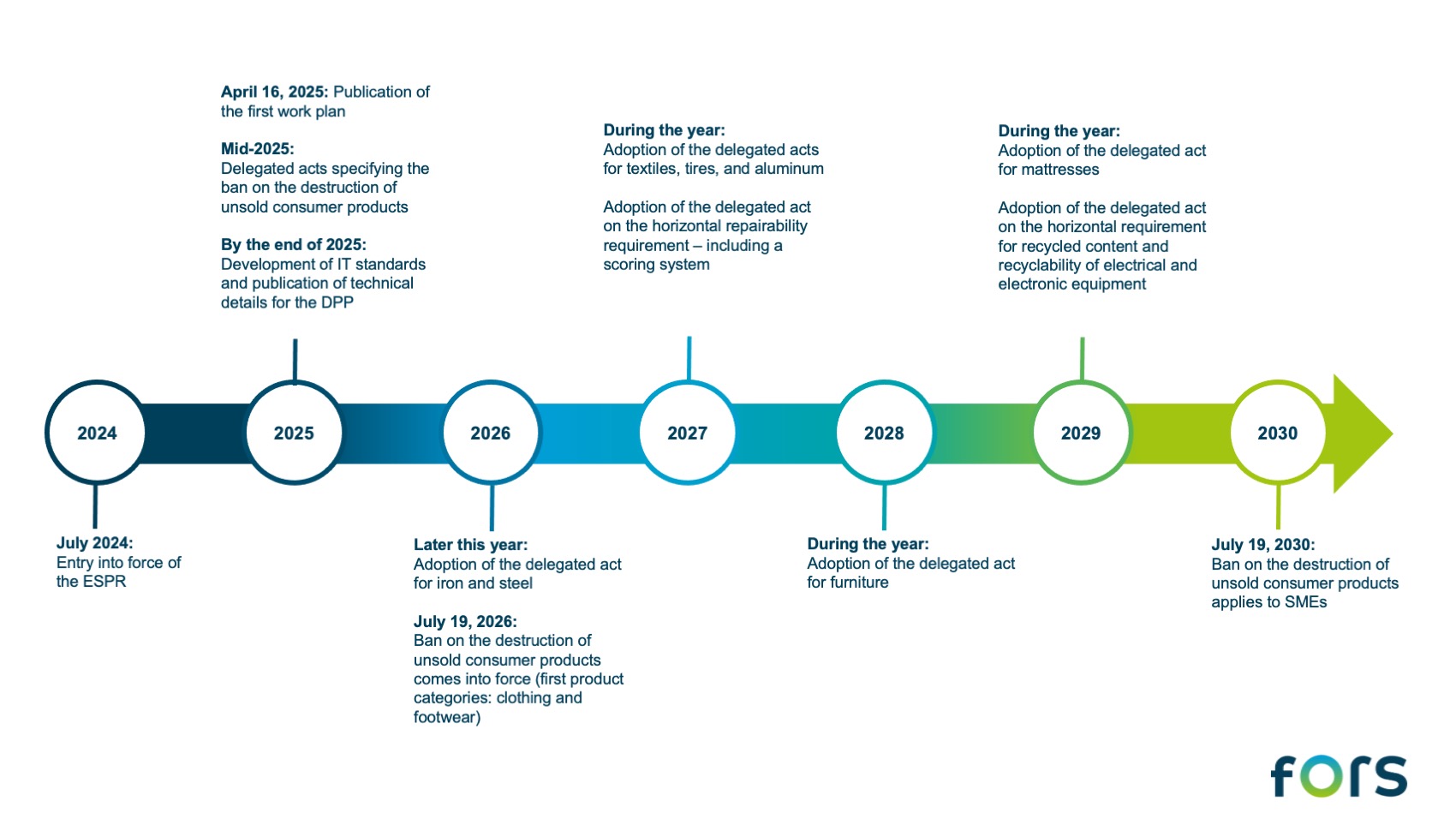
After the entry into force of a delegated act, a transition period of 18 months generally applies to companies; staggered implementation depending on the requirement is possible.
Impact on companies and recommendations for action
The ESPR will have a significant impact in the medium to long term, as it will affect virtually all new products placed on the EU market in the future. It not only entails administrative obligations such as data collection and compliance, but also requires technical and design changes: new design approaches, material strategies, or production processes may be necessary.
This initially entails investment and effort, but also offers opportunities: those who act early can increase resource efficiency, promote innovation and achieve competitive advantages.
Even though details of implementation are still open, there are already clear steps you can take to optimally prepare your company for the ESPR:
- Product and company assessment: Analyze how your products perform in terms of durability, repairability, reusability, and recyclability. Life Cycle Assessments (LCA) are a key tool here. You should also ask yourself: Does my company have the necessary know-how and resources to meet the requirements of the ESPR?
- Ensure data availability: The ESPR requires comprehensive product data (e. g., on materials, energy consumption, and carbon footprint). Start a gap analysis and leverage synergies with existing CSRD data collection processes.
- Product innovation and redesign: Integrate ecodesign principles such as durability and recyclability early on in product development and R&D processes. Creativity is required here.
- Develop new business models: Think innovatively. Retrofitting, repair services, spare parts sales, or product-as-a-service can open up new revenue streams.
- Expand collaborations: Work with suppliers, research institutions, universities, and recycling partners. Focus on data and best-practice sharing to ensure timely compliance with the requirements of the Digital Product Passport. A successful best-practice example of the potential of such collaborations is Catena X, a cross-industry data platform for the secure exchange of various supply chain data.
Tip: The ESPR Readiness Assessment from the World Business Council for Sustainable Development offers a good starting point for more in-depth preparation for the ESPR.
We are happy to answer any questions you may have about ESPR. We can also support you in analyzing your company's impact, implementing the World Business Council's ESPR Readiness Assessment Tool, and evaluating and improving your data availability – if necessary, in collaboration with specialized partners. We are also happy to provide you with initial guidance on implementing the requirements.
Your contact person:

Christina Riediger
Analyst
Phone: +49 151 599 33 664
E-mail: christina.riediger@fors.earth